Honestly Dishonest: The Cheating Brain Unmasked
Are people good or bad by nature, honest or dishonest? What actually goes on in our heads when we decide to be honest or dishonest? And does a fraudster's brain really look different from that of an honest person? Neuroscience is shedding new light on these questions.
I always open my lectures and other talks on (dis)honest behaviour with a question: 'Who here is a fraudster? A liar? Anyone..?' Usually, no hands go up. And yet fraud and other dishonest behaviour are fairly widespread in our society. Think of Lance Armstrong, Elizabeth Holmes or Diederik Stapel. We don't know all that much about the psychology of the liar and the fraudster, though, for the simple reason that it is hard to study: dishonest behaviour generally doesn't take place in public, it is seen as socially undesirable, and so people aren't exactly eager to admit openly that they are guilty of it. In my lab we investigate whether there is something to be learned about dishonest behaviour without asking people about it directly, by looking inside their brains instead. What happens in the brain when people are honest or dishonest? And does a fraudster's brain look different from that of an honest person?
The root of all evil (and of all good)
Psychological theories and philosophy often start from a kind of dualistic view of human nature: inside our heads there is a constant internal battle waged between two aspects or versions of ourselves. One has primitive, selfish motives and cares only about gain, (immediate) reward, power and status. The other is a more developed version of ourselves, which strives to be a 'good' person: sociable, empathic, trustworthy and above all honest and fair.
The idea is then usually that we are constantly tempted to stray from the right path (in other words: the 'bad' side of ourselves is the stronger one, and human beings are bad and sinful by nature) and that we need willpower to stay on the straight and narrow. So whoever has plenty of willpower stays honest, and whoever has too little of it falls prey to their primitive urges and will be dishonest.
Researching dishonest behaviour
In my research I look inside the brain to see how this struggle between good and evil unfolds, and also whether those processes work differently in honest and dishonest people.
To investigate this, we have people perform specific little tasks in the MRI scanner, a large machine that allows us to record their brain activity. But when we want to test for dishonest behaviour, we run into a problem: in an experiment with a researcher hovering around you, recording everything you do and even 'looking inside your brain’, people are surprisingly reluctant to behave dishonestly. To get around this, my colleagues and I developed a new task: the spot-the-differences task, SPOT for short. In this task, participants are shown two pictures and asked to find the three differences between them (see figure 1 for an example). They get six seconds to search, after which they are asked: 'Did you find the three differences, yes or no?'. If they choose 'yes' they receive a small sum of money; if they choose 'no' they get nothing.
The trick with this task is that participants don't have to point out the differences. So cheating is easy and impossible to prove (the experimenter cannot know whether the participant really found the differences or not). However, some pairs of pictures do not contain three differences at all; sometimes there are only 2, sometimes just 1. So, when participants indicate that they have found the differences in those pairs, we know that this is impossible and that they are therefore lying. But the participant doesn't know that we know, and thinks they can cheat with impunity. The beauty of this task is also that we can know exactly when a participant decides to be dishonest. And that is the moment at which we look inside their brain to see what is going on there.

The 'struggle' in the brain
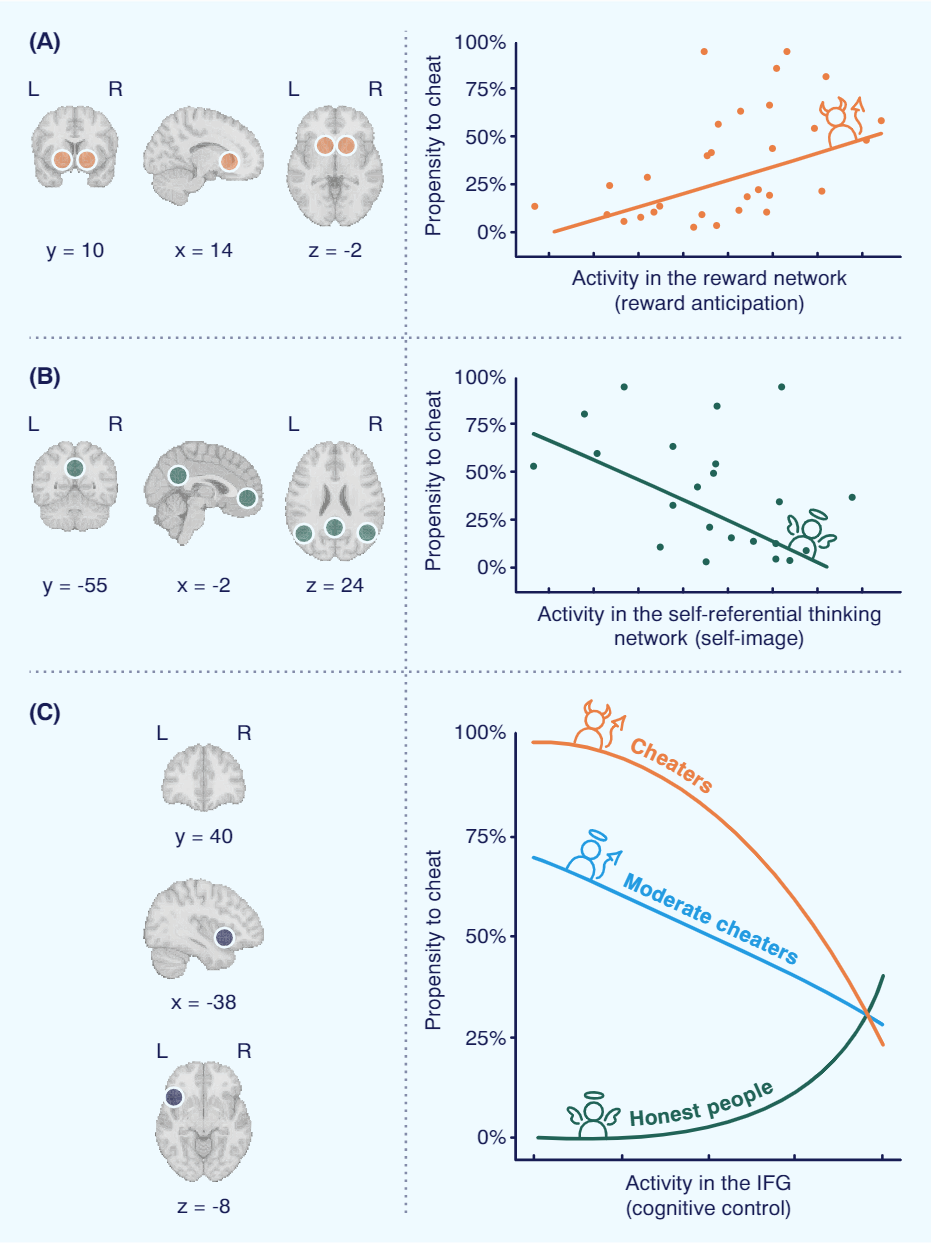
What we see in our MRI images is that two different networks in the brain become more active when people decide to be honest or dishonest. First, we see strong activation in the part of the brain we call the 'reward system' when people decide to be dishonest. This part of the brain (see also figure 2A) is involved in registering and processing aspects of the environment as valuable or rewarding. This is perhaps not hugely surprising: an important reason why people cheat is the gain to be had.
But when we then look inside the brain at moments when people are in fact honest, we see activity in a completely different network in the brain, the self-relevance system (see also figure 2B). This brain network is involved in forming and maintaining a (positive) self-image. What we see is that the stronger the activation in this brain network, the less inclined people are to cheat. So the more important a positive self-image is to someone, the more honest that person will be.
The role of willpower
All of this fits nicely with the idea of a dualistic struggle between the profit-hungry version of our personality and the honest, fair version. But it gets interesting when we look at the role willpower plays in this arena. Willpower, which psychologists also call cognitive control (the mental control you exert over your behaviour), arises from the activity of a specific network in the brain (the 'cognitive control network', see figure 2C). What we see in the brain is that the stronger the activation in the cognitive control network, the less people cheat. This fits with the idea that we need willpower to suppress the 'bad' version of ourselves in order to do the right thing.
But we find this decrease in cheating only in relatively dishonest people. When we look at people who are usually very honest, we see the opposite pattern: the more willpower they exert, the more dishonest they become!
What gives? Willpower, or exerting control over your behaviour, is what allows you to deviate from your default, intuitive behaviour. And that works out differently for different people. If you are dishonest by nature, willpower can make you more honest ('I've cheated so often already, that's really not OK; let me make an effort to be a bit more honest.'). But if you are honest by nature, that same cognitive control can make you think 'hang on a minute, I'm being a bit of a sucker here, letting all that money pass me by; surely being a little bit dishonest now and then can't hurt…'.
So, willpower pulls people towards the middle, away from their default, intuitive behaviour. It allows us to find a subjectively optimal balance between the motivations of our two 'selves': achieving gain and success, and maintaining a positive image of ourselves. So it isn't the case that willpower by definition makes us better, more honest people: it depends entirely on what kind of person you are.
Detecting fraudsters in the MRI scanner
An interesting question now is whether we can predict, on the basis of someone's brain scan, how (dis)honest that person is. Our research shows that we can indeed. What is also interesting is that it is precisely the functioning of the networks mentioned earlier (the reward system and the self-relevance system) that is predictive: in honest people the reward system is strongly coupled to the self-image system, but in dishonest people this is much less the case. So the strength of these connections can be used to make predictions about the honesty of the person in the scanner: the stronger the connections between the two systems in the brain, the more honest the person in question is.
It appears, then, that for dishonest people the pursuit of gain and their self-image (being a 'good' person) are fairly separate things. These people are able to go all out for self-interest, profit and success without this affecting their self-image. For honest people, behaviour relating to gain and reward is in fact strongly coupled to their self-image. For them, a positive self-image is highly rewarding.
The honest conclusion
In summary, we can say that differences in honesty between people are related to a struggle in our brain, between the reward network and the self-image network. In honest people this struggle is usually won by the motivation to maintain a positive self-image. In fraudsters it is won by the motivation for gain and reward. This is because in these people a positive self-image is fairly decoupled from going all out for gain. Willpower can keep dishonest people on the straight and narrow. But beware: willpower can push honest people off it!
The studies described in this text can be read here:
- Speer, S. P. H., Smidts, A. & Boksem, M. A. S. Cognitive control and dishonesty. Trends Cogn Sci 26, 796–808 (2022). https://doi.org/10.1016/j.tics.2022.06.005
- Speer, S. P. H., Smidts, A. & Boksem, M. A. S. Individual differences in (dis)honesty are represented in the brain’s functional connectivity at rest. Neuroimage 246, 118761 (2022). https://doi.org/10.1016/j.neuroimage.2021.118761
- Speer, S. P. H., Smidts, A. & Boksem, M. A. S. Cognitive control increases honesty in cheaters but cheating in those who are honest. Proc National Acad Sci 117, 202003480 (2020). https://doi.org/10.1073/pnas.2003480117