Honestly Dishonest: The Cheating Brain Unmasked
Are people good or bad by nature, honest or dishonest? What actually goes on in our heads when we decide to be honest or dishonest? And does a fraudster's brain really look different from that of an honest person? Neuroscience is shedding new light on these questions.
I always open my lectures and other talks on (dis)honest behaviour with a question: 'Who here is a fraudster? A liar? Anyone..?' Usually, no hands go up. That could mean one of two things. First, that I only ever speak to extremely respectable audiences. That can't be ruled out, but it's more likely that my audience isn't answering the question entirely honestly.
We don't know all that much about the psychology of the liar and the fraudster, for the simple reason that it is hard to study: dishonest behaviour generally doesn't take place in public, it is seen as socially undesirable, and so people aren't exactly eager to admit openly that they are guilty of it.
In my lab we investigate whether there is something to be learned about dishonest behaviour (by which we mean fraud, cheating, lying and deception) without asking people about it directly, by looking inside their brains instead. What happens in the brain when people are honest or dishonest? And does a fraudster's brain look different from that of an honest person?
Dishonest behaviour is widespread in our society
Even though nobody in my audience ever claims to be a dishonest person, dishonest behaviour is in fact quite common, and it has a major impact on society as well. There are plenty of examples, from every corner of public life.
In sports, for instance, cheating is a common phenomenon. One prominent case is of course Lance Armstrong, who managed to win the Tour de France no fewer than seven times, but not without using doping (EPO). In a very different sport, Hans Niemann made the news a while back when he was accused of cheating by having information passed to him from outside in a remarkably ingenious way (this was, incidentally, never proven).
In the business world, too, fraud never seems far away. A major case in the US involves Theranos, a startup led by Elizabeth Holmes that had supposedly developed a technique capable of detecting a range of diseases from just a single drop of blood. Billions of dollars of investment followed. Unfortunately, it soon turned out that the technique didn't exist at all. Patients misled, investors out of pocket. Holmes is currently serving an 11-year prison sentence. Closer to home we had the case that became known as the 2013 Horse Meat Scandal: it was found that various products in the EU that were advertised as beef actually contained horse meat, sometimes up to 100%. Of course, horse meat is much cheaper than beef, so a lot of money was made by selling it as beef. The EU launched an investigation and found several companies involved in the fraud, among them a trader operating in the Netherlands called Draap Trading Ltd. Draap spelled backwards is paard, the Duch name for horse…
Finally, I'm afraid I can't leave my own profession, science, unmentioned. In the Netherlands we were confronted some years ago now with the fraudulent practices of Diederik Stapel. For years, this professor of psychology published research findings that really captured the imagination, until it emerged that rather too much imagination had been involved: the studies his results were based on had never been carried out at all: he simply made them up in his study at home. More recently there is the case of Francesca Gino, a professor at the prestigious Harvard Business School. She, too, was accused of falsifying research results; this has since been demonstrated, and she has now been stripped of her title as well. Unlike Stapel, however, Gino has never admitted her fraud. What makes this case especially painful is that her expertise lay in the field of ethics and (dis)honest behaviour.
The root of all evil (and of all good)
So people are often not honest. External factors such as oversight (think of supervisory boards, police checks, the four-eyes principle, and so on) and the threat of punishment or fines can keep this in check to some extent, but the evidence that this works well is not strong: tougher sentencing, for example, generally does not lead to much less crime.
But even with oversight and harsh punishments there are still fraudsters and, perhaps more relevant still, in situations without any oversight plenty of people are simply honest. How does that work? In my research I try to gain more insight into the psychology and the brain of the fraudster: what is it that makes people good or bad, honest or dishonest?
Both psychological theories and philosophy often start from a kind of dualistic view of human nature: inside our heads there is a constant internal battle waged between two aspects or versions of ourselves. One has primitive, selfish motives and cares only about gain, (immediate) reward, power and status. The other is a more developed version of ourselves, which strives to be a 'good' person: sociable, empathic, trustworthy and above all honest and fair.
The idea is then usually that we are constantly tempted to stray from the right path (in other words: the 'bad' side of ourselves is the stronger one, and human beings are bad and sinful by nature) and that we need willpower to stay on the straight and narrow. So, whoever has plenty of willpower stays honest, and whoever has too little of it falls prey to their primitive urges and will be dishonest.
Researching dishonest behaviour
In my research I look inside the brain to see how this struggle between good and evil unfolds, and also whether those processes work differently in honest and dishonest people.
To investigate this, we have people perform specific little tasks in the MRI scanner, a large machine that allows us to record their brain activity. This is how neuroscience research usually works: we have special tasks for all sorts of psychological processes: for memory, attention, planning, spatial reasoning, and so on. We have people perform these tasks in the scanner to see how the brain is involved in these processes.
But when we want to test for dishonest behaviour, we run into a problem: in an experiment with a researcher hovering around you, recording everything you do and even 'looking inside your brain’, people are surprisingly reluctant to behave dishonestly. So, we need to come up with a task in which participants at least feel that they are not being watched.
One task that is widely used in behavioural psychology research is the so-called die-under-the-cup task. The participant sits at a desk with a computer on it and (the name gives it away) a die and a cup. The task is simple: shake the die under the cup, look at what you have rolled (there is a hole in the top of the cup so that only the participant can see the outcome), and enter it on the computer. Participants are told in advance how payment for this experiment works. That, too, is very simple: roll a 1 and you receive €1, roll a 2 and you receive €2, a 3 gets you €3, and so on.
Imagine you are a participant in this experiment. You shake, you look, and: you have rolled a 1... What do you enter on the computer? Now, the chance of rolling 1 is about 16.7%, exactly the same as the chance of rolling 2, 3, and so on. But when you look at what participants report, you see something rather different: remarkably few 1s and 2s get rolled, and an awful lot of 5s and 6s... Participants are not being honest: they are cheating! Some of them, at least; it isn't the case that nothing but 6s get reported. But who were these cheaters? There is no way to find out, since we cannot observe the actual roll (the die is under the cup). And of course it isn't true that everyone reporting a 6 is a cheater: rolling a six is, after all, just as likely as rolling a 1.
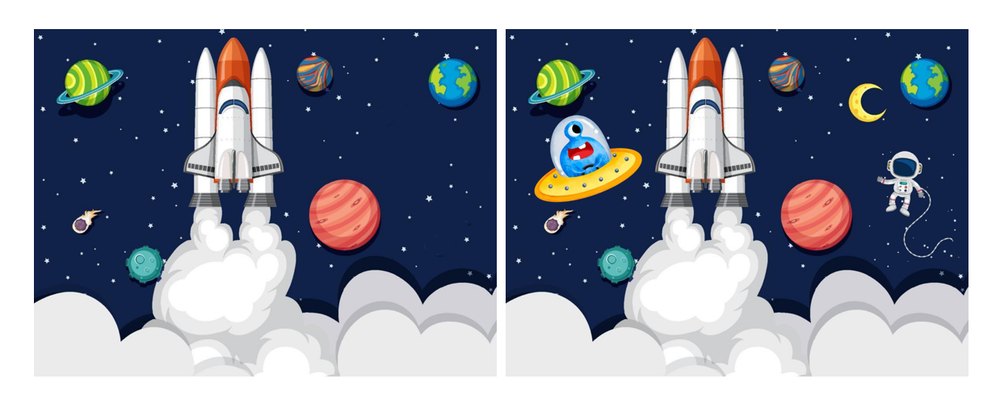
But in order to look inside a cheater's brain, we really do need to know with certainty who cheated and who did not. To get around this problem, my colleagues and I developed a new task: the spot-the-differences task, SPOT for short. In this task, participants are shown two pictures and asked to find the three differences between them (see figure 1 for an example). They get six seconds to search, after which they are asked: 'Did you find the three differences, yes or no?' If they choose 'yes' they receive a small sum of money; if they choose 'no' they get nothing.
The trick with this task is that participants don't have to point out the differences. So cheating is easy and impossible to prove (the experimenter cannot know whether the participant really found the differences or not). However, some pairs of pictures do not contain three differences at all; sometimes there are only 2, sometimes just 1. So, when participants indicate that they have found the differences in those pairs, we know that this is impossible and that they are therefore lying. But the participant doesn't know that we know, and thinks they can cheat with impunity.
In our experiment, participants judge a great many of these picture pairs (some 150 of them). Even though the amount they receive per difference found is small, the total to be won over those 150 pairs adds up quite nicely, to more than €35, which for students (our participants are usually students) is a rather decent sum. The beauty of this task is that we can know exactly when a participant decides to be dishonest. And that is the moment at which we look inside their brain to see what is going on there.
How do people behave in this task? Over the past few years we have tested hundreds of participants with it, and the pattern is always the same. What we do not see is that most people are fundamentally honest, but nor do we see that most people are liars and cheats. The truth lies somewhere in between: yes, there are people who are scrupulously honest, and there are also people who let almost no opportunity to cheat pass them by, but most find themselves somewhere between these extremes. The distribution is almost completely flat, meaning that every degree of dishonesty occurs about equally often.
The 'struggle' in the brain
So what actually happens in the brain when people are honest or dishonest? We can investigate this by administering the SPOT inside the MRI scanner. That allows us to visualize activation in the brain occurring at precisely the moment people make the choice to be honest or dishonest. So what do we see happening?
It is useful to look first at people who cheat a great deal. What we see in them is very strong activation in the part of the brain we call the 'reward system'. This part of the brain (more precisely, the striatum or nucleus accumbens; see also figure 2A) is involved in (the name says it all) registering and processing aspects of the environment as valuable or rewarding. Think of beautiful cars, clothes, good food, attractive people, money of course, but also power and status. It is precisely this reward system that becomes active when people decide to cheat: the stronger the activation in this part of the brain, the more they cheat. Perhaps not hugely surprising: an important reason why people cheat is the gain to be had.
But when we then look at people who are in fact very honest, we see something quite different in their brains: activity in another network in the brain, the self-relevance system (for the neuroscientific connoisseurs: the medial prefrontal cortex and the precuneus, see also figure 2B). This brain network is involved in forming and maintaining a (positive) self-image and in processing aspects of the environment that are relevant to you as an individual. What we see is that the stronger the activation in this brain network, the less inclined people are to cheat. So the more important a positive self-image is to someone, the more honest that person will be.
The role of willpower
So far, the findings fit nicely with the idea of a dualistic struggle between the profit- and power-hungry version of our personality and the honest, fair version. But it gets interesting when we look at the role willpower plays in this arena. Willpower, which psychologists also call cognitive control (the mental control you exert over your behaviour), arises from the activity of a specific network in the brain (the 'cognitive control network', see figure 2C) consisting of the mediodorsal prefrontal cortex and the lateral prefrontal cortex. What we see in our participants' brains is that the stronger the activation in the cognitive control network, the less they cheat. This fits with the prevailing idea that we need willpower to suppress the 'bad' version of ourselves in order to do the right thing.
But we find this decrease in cheating only in individuals who cheat a great deal of their own accord, in relatively dishonest people, that is. When we look at people who are usually very honest, we see the opposite pattern: the more willpower they exert, the more dishonest they become!
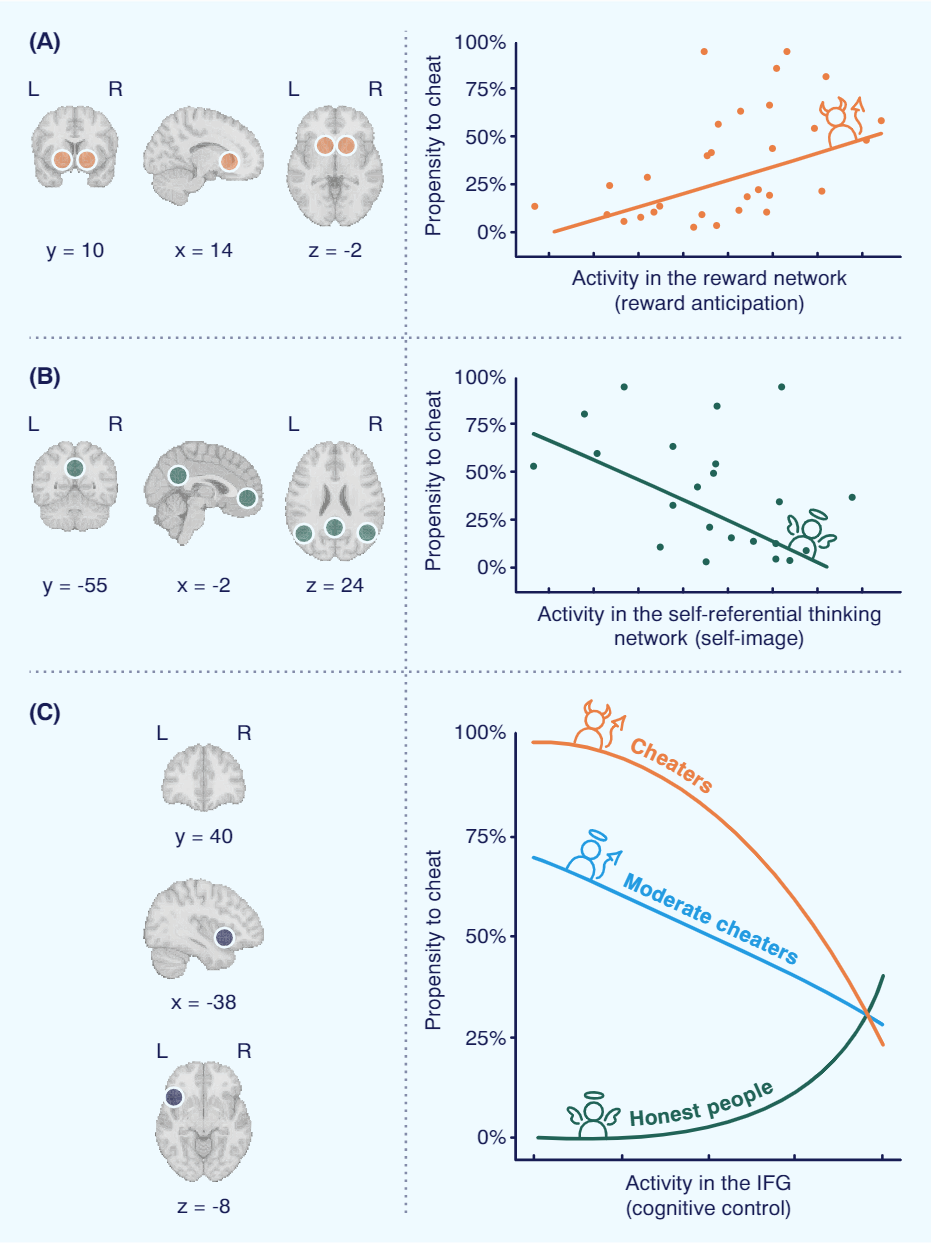
How do we explain this? We have seen that people find themselves somewhere on a spectrum from very honest to very dishonest. In other words, some of us are naturally very honest, others are naturally very dishonest. Willpower, or exerting control over your behaviour, is what allows you to deviate from your natural, intuitive behaviour. And that works out differently for different people. If you are dishonest by nature, willpower can make you more honest ('I've cheated so often already, that's really not OK; let me make an effort to be a bit more honest.'). But if you are honest by nature, that same cognitive control can make you think 'hang on a minute, I'm being a bit of a sucker here, letting all that money pass me by; surely being a little bit dishonest now and then can't hurt...'.
So willpower pulls people towards the middle, away from their default, intuitive behaviour. It allows us to find a subjectively optimal balance between the motivations of our two 'selves': achieving gain and success, and maintaining a positive image of ourselves. So it isn't the case that willpower by definition makes us better, more honest people: it depends entirely on what kind of person you are.
Detecting fraudsters in the MRI scanner
But there are, then, large differences in honesty between people; can those differences also be found in the brain? Is it the case that the brains of fraudsters are simply wired differently from those of honest people? We investigated this by taking a so-called 'resting state MRI scan' from a large number of people. Here we measure the intrinsic activity of the brain while people are doing nothing (are 'at rest') in the MRI scanner. We also have them do the SPOT, usually a few days later. What we can then do is relate their performance on the SPOT (how (dis)honest are they?) to their intrinsic brain activity: can we predict, on the basis of someone's brain scan, whether we are dealing with a fraudster or with an honest person?
Our research shows that we can indeed: a brain scan taken while someone is doing 'nothing' can be used to make fairly accurate predictions about the honesty of the person concerned. Also interesting is which brain networks were most informative for this prediction; in other words, where in the brain do we find the biggest differences between honest and dishonest people? Here the same networks turn up again: the reward system and the self-relevance system. In honest people, the reward system is strongly coupled with the self-image system, but in dishonest people this is much less the case. So the strength of these connections can be used to make predictions about the honesty of the person in the scanner: the stronger the connections between the two systems in the brain, the more honest the person in question is.
It appears, then, that for dishonest people the pursuit of gain and their self-image (being a 'good' person) are fairly separate things. These people are able to go all out for self-interest, profit and success without this affecting their self-image. For honest people, behaviour relating to gain and reward is in fact strongly coupled with their self-image. For them, a positive self-image is highly rewarding.
The fraudulent personality
One comment I get when I talk about these findings is something along the lines of 'yes, all those different activations in the brain are nice and all, but how are honest and dishonest people really different, in terms of personality?'. Obviously, all personality differences arise from the brain, but what people mean is how honest and dishonest people answer personality questionnaires. We have investigated this as well. What we found is that dishonesty is mainly associated with impulsivity: the more impulsive people are, the more dishonest they tend to be. Other personality characteristics related to how honest someone is, have to do with answers to questionnaires about how important morality is to them. What we find is that the answers to these kinds of questions are strongly related to how honest someone is, but in exactly the opposite direction from what you would expect: the more strongly people say they value morality, the more dishonest they are. What we conclude from this is that dishonest people also give dishonest answers on personality questionnaires.
Fraud 'in the real world'
A second question I often get is something like: 'OK, but does dishonesty in the lab really tell us anything about honesty in real life?'. What is really being asked here is about the validity and generalizability of measuring dishonest behaviour with tasks such as the SPOT or the die-under-the-cup task. A great deal of research has been done on this. It turns out, for example, that the more dishonest people in a given country are on average on this kind of task, the more corruption takes place in that country. Convicted criminals are more dishonest on these tasks than non-criminals, but so are bankers, for instance. These tasks are also related to things like fare-dodging on public transport and cheating on exams.
Can fraud be prevented?
In conclusion, it can be said that (dis)honest behaviour can indeed be seen as an internal struggle between gain, reward, power and status on the one hand, and the motivation to be a 'good' person with a positive self-image on the other. But it is not the case that exerting willpower always has a positive effect: for dishonest people it works out well (they become more honest), but for honest people it does not (they become a little more dishonest).
That is of course fascinating, but do these insights also give us something to base interventions on? What can companies do, for example, to prevent fraud among their employees, or at least to limit it? A natural way to approach this would be to consider whether we can intervene in each of the processes we identified in our research.
Since the drive for gain and reward is an important motivation for dishonest behaviour, one idea might be not to pay out excessively large rewards. However, it is not the case that people who earn a lot of money are by definition more dishonest than people who earn less. What has been demonstrated is that arbitrary or performance-related bonuses can lead to more fraud. Research also shows that setting performance targets that are hard to reach is particularly likely to encourage dishonest behaviour. You can picture it: you get a nice bonus if your department makes 100k in profit this month, but towards the end of the month you are just short of your target, at 98k... What do you do in that case? It turns out that a simple system in which the reward increases linearly per unit of work leads to considerably less fraud than a system based on targets set in advance. Implementing rewards sensibly can promote honesty in the workplace.
Second, changes to the environment that encourage employees' self-image to be actively engaged can likewise contribute to more honest behaviour. A well-known experiment shows that when a mirror was hung next to the coffee machine at work, people paid more honestly for their coffee. What's more, increasing the focus on self-image through mindfulness can also lead to greater honesty. Cues in the environment that remind people of their self-image can therefore help to limit dishonest behaviour.
But the biggest gains in terms of curbing dishonest behaviour are probably to be made through changes in company culture. If that culture is a positive one, focused not on money, status and power but on cooperation, safety and ethics, then a positive self-image (and someone's standing in the organization) depends less on reward and more on their integrity. In a culture like that, fraud would be completely pointless.
The honest conclusion
In summary, we can say that cheating, fraud and lies are relatively common phenomena. But not everyone is a fraudster; plenty of people are simply honest, even without the threat of punishments or fines. These differences between people are related to a struggle in our brain, between the reward network and the self-image network. In honest people this struggle is usually won by the motivation to maintain a positive self-image. In fraudsters it is won by the motivation for gain, status and reward. This is because in these people a positive self-image is fairly decoupled from going all out for gain. For dishonest people in particular, willpower can keep them on the straight and narrow. But beware: willpower can push honest people off it!
The studies described in this text can be read here:
- Speer, S. P. H., Smidts, A. & Boksem, M. A. S. Cognitive control and dishonesty. Trends Cogn Sci 26, 796–808 (2022). https://doi.org/10.1016/j.tics.2022.06.005
- Speer, S. P. H., Smidts, A. & Boksem, M. A. S. Individual differences in (dis)honesty are represented in the brain’s functional connectivity at rest. Neuroimage 246, 118761 (2022). https://doi.org/10.1016/j.neuroimage.2021.118761
- Speer, S. P. H., Smidts, A. & Boksem, M. A. S. Cognitive control increases honesty in cheaters but cheating in those who are honest. Proc National Acad Sci 117, 202003480 (2020). https://doi.org/10.1073/pnas.2003480117